Among all of Carrozzeria Touring’s post-war work, this sole Pegaso is one of their most thrilling. Being a one-of, that allowed it to be much more daring than standard practice. In 1951, Pegaso was building Spain’s only sports car on a steel tube frame, aluminum V8 engine and rear transaxle. Known as the Z-102, these were meant for the high-end market and attracted work from the Europe’s premier coachbuilders.
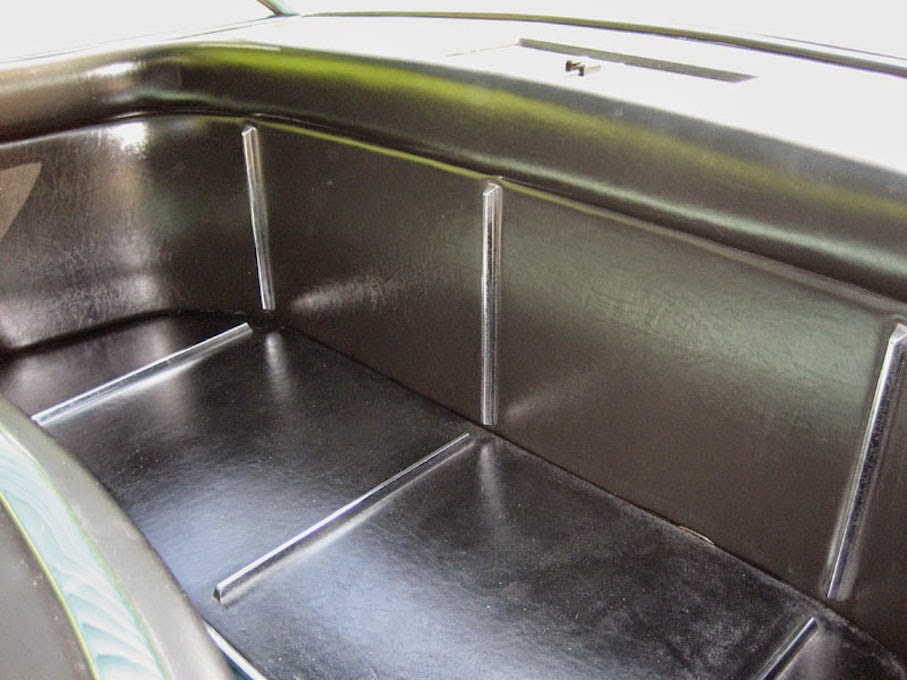
Three years into production, Wilfredo P. Ricart, a Spanish car designer, approached Touring to make a new show car on the Z-102 chassis. Pegaso’s mother company, Empresa Nacional de Autocamiones S.A., (ENASA) paid for the work. Like many extravagant Pegasos, the Thrill was planned for the 1953 Concours d’Elegance. A cross-haired grill was the only visual cue that marked the Thrill as a Peagso. Touring styled a completely new body shape and interior that was fitting for the car’s name. The design used unfamiliar yet balanced lines and accentuated them with a high-contrast, red-on-black paint scheme. From the outside, the most immediately noticeable trait is the car’s two flying buttresses that form the leading edge of the rear wings. These are a definite nod to America'a jet-age design, but the rounded edges make the Thrill appear less threatening. (supercars.net)


Three years into production, Wilfredo P. Ricart, a Spanish car designer, approached Touring to make a new show car on the Z-102 chassis. Pegaso’s mother company, Empresa Nacional de Autocamiones S.A., (ENASA) paid for the work. Like many extravagant Pegasos, the Thrill was planned for the 1953 Concours d’Elegance. A cross-haired grill was the only visual cue that marked the Thrill as a Peagso. Touring styled a completely new body shape and interior that was fitting for the car’s name. The design used unfamiliar yet balanced lines and accentuated them with a high-contrast, red-on-black paint scheme. From the outside, the most immediately noticeable trait is the car’s two flying buttresses that form the leading edge of the rear wings. These are a definite nod to America'a jet-age design, but the rounded edges make the Thrill appear less threatening. (supercars.net)


.jpg)
.jpg)
.jpg)
.jpg)
.jpg)
.jpg)
.jpg)
.jpg)
.jpg)
.jpg)
.jpg)


(Photos from ultimatecarpage.com, supercars.net, coachbuild.com & mgcarclubantwerp.be)


.jpg)
.jpg)